Don Quixote on Fahrenheit 451
In 1953, Ray Bradbury wrote Fahrenheit 451, whose title refers to the temperature on the Fahrenheit scale at which book paper catches fire and burns. In 1966, François Truffaut presented his agonizing film adaptation. In Spain, we are commemorating the 400-year anniversary of the death of Cervantes, author of Don Quixote. I explain that Cervantes wrote Quixote because in the last few years I have met many students from every corner of the world who do not know that fact. Fahrenheit 451 presents a society where the firefighters’ mission is to burn books because, according to the government, reading prevents people from being happy and generates questions, reservations and anxiety. But when the goal of power is one-dimensionality (Marcuse, 1991)—meaning that everyone is the same, that everyone works more efficiently so that we consume a lot, and that everyone is very happy not questioning the system—the most serious thing is that reading makes us different.

Firefighters burning books in Truffaut’s film.
In Bradbury’s fable, television becomes the main companion, continuously broadcasting programs that don’t make sense but which keep the audience addicted, even to the point that a viewer takes out a second mortgage in order to knock down the walls of his house and replace them with gigantic screens so that he can watch the most television possible. Perhaps Bradbury was incorrect about knocking down the walls, but not about the idea: doesn’t it resemble this universe full of zombies absorbed in their smartphones that we have become? Somebody told me that a few months ago they presented an elderly couple with private photos and videos of a family from Los Angeles (“the name of which I have no desire to call to mind”): she is a ridiculous model and he is an exhibitionist rapper, who already have fifty million human beings that follow them with discipline in order to enter into their daily lives and see which dress she has selected or if the family fell asleep on the couch. These elderly folks who come from a village in Castilla la Mancha, like Don Quixote, also had trouble understanding how such utter stupidity kept fifty million citizens (I repeat the number to highlight it) checking social networks with strict discipline.
At the end of the last decade I participated in a few protests against the so-called European Higher Education Area, demonstrations supported by almost one hundred percent of all areas of the European academic world. As it often happens in politics, the surest way to silence resistance against a regressive and degrading process is to present it to the public according to the demagogic strategy. With regard to this process, the strategy consists of saying that (only the part that sounds nice) the reform would allow practically all university students to find qualified employment upon graduating, that the students would be able to travel freely between European universities, and that the diplomas issued would be valid throughout the EU. Can anyone really be against something like that? Of course not. However, what they did not explain is the programmed “substitution of the cognitive contents with their containers […] the destruction of scientific research’s theoretical and doctrinal articulations in order to render them marketable skills and abilities”, ultimately, “cultural poverty and the degradation of knowledge into merchandise,” as Jorge Pardo, Professor of Philosophy at UCM (Pardo, 2008), notes.
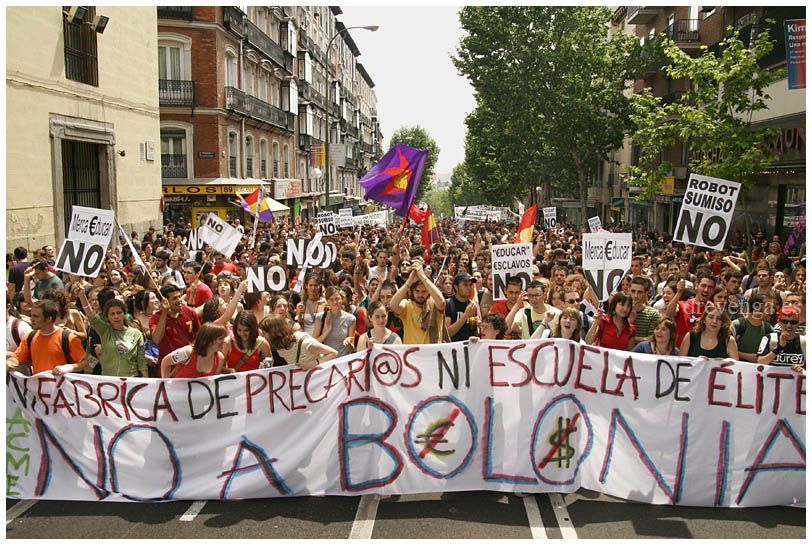
Spanish Demostration against the European Higher Education Area, Plan Bologna, 2008.
Cervantes was born in Alcalá de Henares, but could not attend its prestigious university, one of the oldest in the world, because he needed to work. He had to attend individual classes at private institutions in order to get an education. It would never have occurred to the one-armed man, or to the rest of the Humanists, that the University was a place to facilitate access to work; it was a place to deepen “knowledge.” “Knowledge,” here is the key word that seems to have transmuted in the 2.0 era. To understand the change we have to review its origin. “Knowledge” comes from the Greek gnosis (γνῶσις) which is closer to what we now understand as Wisdom or Intellectuality, words that are almost offensive nowadays. It took on its fuller meaning with Socrates who related gnosis with knowledge of oneself. Conversely, the present “Knowledge” is closer to “information”, derived from Latin information(-nis), used to indicate a “concept” or an “idea” and is a translation of the Greek word «μορφή», morfè, used to indicate the ideal identity or essence of something. Essentialism has always been the most effective method for controlling thought. When faced with words like Truth, Good, Bad, Progress, Stability, Liberty, the establishment can manipulate their meanings whenever a citizen assumes these words respond to essential ideas, immutable ideas, but which curiously correspond to what official Law determines. Thus, when applied in this essentialist way, it is possible to justify anything as being Good, Truth and Justice, from the Republic that Plato presented, to the annihilation of an entire religious ethnic group in Europe in the 30’s and 40’s (Popper, 2011). Therefore, Knowledge has become Information, a conglomeration of summaries that are fed to the individual, who will accept them as valid since they help him fit in “as he is supposed to be” or, in other words, fit perfectly into what the Market demands (Market is another word used by international politicians as an abstract essence to thus avoid explaining the who, how, and why). Information is Power and Knowledge is wisdom of oneself: the red and blue pills of The Matrix.

When I was sixteen and they told us about an author or issue in high school, reading the entirety of one of their books was normally part of it. I can confirm that now all this has ended and that students are only provided with summaries and some half-page texts. Meanwhile the design of high school curricula has added practical materials that, although they don’t make one think about oneself and society (gnosis), provide one with concrete skills that already get him/her thinking about the degrees that are highly valued by multinationals. This reduction of content has begun to be implemented at all levels of education, as if they somehow wanted to send the firefighters to burn the books but that it is still politically incorrect to say that out loud.
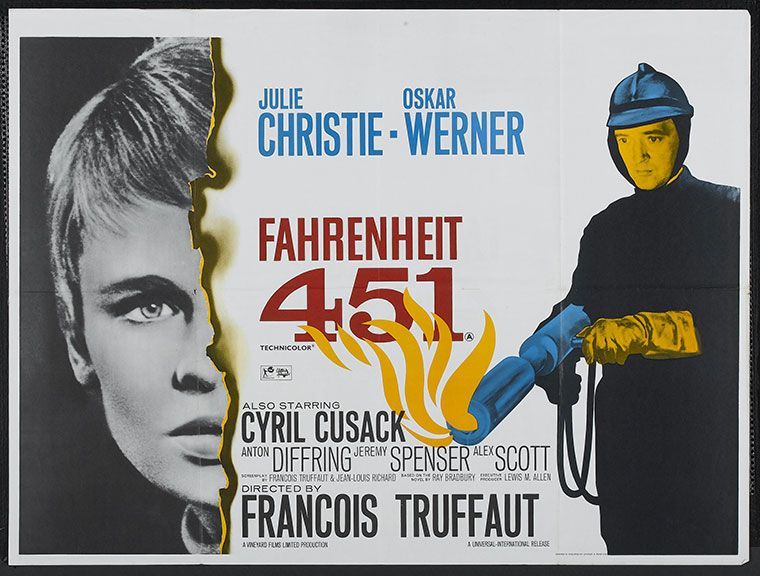
Scene from Truffaut’s film: A books lover prefers to die with her Library
Cervantes wrote a book with between 500 and 1000 pages, depending on the edition. It is the second most translated book in history after the Bible, so in a world like Fahrenheit 451, it would be the second most burned book on the Earth. Don Miguel de Cervantes, like the rest of the Humanists, had assumed that in order to attain knowledge, one had to submerge oneself in great oceans of letters. Now it is very difficult to find a university student that doesn’t get scared away by a bibliography that cannot be summarized in ten pages of formulas searched online. But then, how will he know that these formulas that they supply are the appropriate ones and that they have not been manipulated or distorted or interpreted in a certain way by one of those suspicious elements that professors always are?
An academic journey can only be immersion in a rich range of grand books that somehow helps furnish the mind—the sweet consumption of little pills with which we acquire the technical concepts for certain fields of the labor market is quite another thing. That is the question. In the four-hundred year commemoration of the death of Cervantes, one can say that the pages of Don Quixote have started to burn, just like those of Marcuse, Popper and Bradbury. Few Media students know Truffaut’s filmography—cinema is also not saved from the fire. But I’m optimistic that, like in Bradbury’s book, there will continue to be a group of Quixotes that will forget the smartphone at home and bring one of those fat books that make us think about what is human. My work at MIUC is this: educate Quixotes.

Author: Jesús Eguía
References:
Bradbury, R. (2012), Fahrenheit 451, London: Simon & Schuster.
Marcuse, H. (1991), One-Dimensional Man: Studies in the Ideology of Advanced Industrial Society, Boston: Beacon Press.
Pardo, J. L. (2008), “La descomposición de la Universidad”, El País, 20/09/2008.
URL: http://elpais.com/diario/2008/11/10/opinion/1226271612_850215.html
Popper, K.R (2011), The Open Society and Its Enemies, UK: Routledge.
Wachowski B. (1999), The Matrix, Warner Bros.