The marginalisation of philosophy in globalisation discussions
“For the very first time the members of the Faculty for Worldwisdom are unable to say anything more about this totalisation than the reader of a newspaper in a country with a half-free-press.”
Although Sloterdijk admits that the marginalisation of philosophy in this discussion is not a regrettable fact by itself, he points out four issues.
First, that debates on globalisation are being monopolised by “amateurs” (political and social scientists, economists and journalists) who use (not recognised as being) philosophical terms, as a basis for their debates.
Secondly, that philosophising without taking the state of the art into account only creates myths generated by suggestions and twists of sense.
Thirdly, that these myths have, more often than not, dangerous consequences.
And fourthly, that these unchecked statements proliferate globally. Sloterdijk remains very vague about the dangers of these “myths”, and only refers to “politically virulent hypotheses”.
It is not the dangerous consequences of such myths that is my primary concern here but the assumptions/injunctions Sloterdijk is making.
Are “amateurs” not allowed to use terms such as “globality”, “wholeness”, “space”, “time”, “situation”, “unity”, “multiplicity”, “interaction”, “inclusion”, “exclusion”?
Or are the “members of the (philosophical) craft” the only ones competent to debate, in this case, on globalisation?
 Is the marginalisation of philosophy (if there is such a thing) not the consequence of such corporatist reflexes? It is fine for philosophers to stand their ground, but how can philosophy stop humans creating myths? Is this its role?
In my view, philosophy has always been, and will probably remain, a marginal occupation. The monetisation to which philosophy partakes is very limited.
It’s most significant contribution in this regard is probably through the generation of text, and to a lesser extend to the pre-eminence of some personalities (as in the case of Peter Sloterdijk as a recognised intellectual), but certainly not through images, and certainly not through numbers or goods.
But this does not imply that rigorous thinking is not important and that the lack thereof may have “dangerous consequences”.
What really bothers me is the surge of “para-philosophy” in the area of business management literature. I have the uneasy feeling that philosophers are not taking up their positive role as “concept custodians” in this sector of human activity, which draws upon an impressive mass of intellectual talent.
When I write “positive role” I mean helping people and organisations to be more effective in analysing the consequence of monetisation, rather than helping humanity avoid “dangerous consequences”.
Let me mention one example: the question of the difference between a (business) process and a project. Most managers will consider this an academic issue, but the vast majority of philosophers don’t take this question into account, although these are two concepts with significant philosophical meaning and tradition.
The resolution of this question could have considerable practical consequences for the day-to-day running of organisations and the way people understand their jobs.
I see at least three possible benefits of such a philosophical clarification. First, it could define what type of contract binds an individual to an organisation.
Secondly, it could clarify the accountability and responsibility of the individual and improve the transparency of the organisational impact of such a contract.
Thirdly, it could significantly improve the quality of communication, and hence of management, within the organisation.
What the ontological difference is between processes and projects, and how its resolution could benefit organisations, is not the topic of this paper.
I will limit myself to the illustration of the poor quality of the business “para-philosophical” thinking and publications. I propose readers decide for themselves how philosophical rigour could help improve the unchecked proliferation of conceptual confusion.
Concretely, my example is about the definition of the concept of “business process” and its characteristics. Let’s start with the definition. Out of a myriad of options, I have picked three.
A business process is:
“a series of steps designed to produce a product or service.”
“a specific ordering of work activities across time and place, with a beginning, an end, and clearly identified inputs and outputs: a structure for action.”
“the complete and dynamically coordinated set of collaborative and transactional activities that deliver value to the customer.”
These three definitions would make an ideal exercise for an undergraduate philosophy student yet “professional philosophers” consider the subject too insignificant to bother to analyse it.
The authors of the third definition have considered (rightly, in my opinion), that their definition needs to be supplemented by a list of characteristics of what a business process is.
Business processes are:
“Large and complex, involving the end-to-end flow of materials, information and business commitments.
Dynamic, responding to demands from customers and to changing market conditions.
Widely distributed and customised across boundaries within and between businesses, often spanning multiple applications on disparate technology platforms.
Long-running – a single instance of a process such as “order to cash” or “develop product” may run for months or even years.
Automated – at least in part. Routine or mundane activities are performed by computers wherever possible, for the sake of speed and reliability.
Both “business” and “technical” in nature – IT processes are a subset of business processes and provide support to larger processes involving both people and machines.
End-to-end business processes depend on distributed computing systems that are both transactional and collaborative:
“Dependent on, and supportive of, the intelligence and judgement of humans. People perform tasks that are too unstructured to delegate to a computer or that require personal interaction with customers.
“People also make sense of the rich information flowing through the value chain, solving problems before they irritate customers and devising strategies to take advantage of new market opportunities.
“Difficult to make visible. In many companies business processes have been neither conscious nor explicit. They are undocumented, embedded, ingrained and implicit within the communal history of the organisation, or if they are documented, the documentation or definition is maintained independently of the system that supports them.”
The book containing this text has been published by a business publishing house and has been endorsed by business process management organisations.
One doesn’t need to be a corporatist purist to understand that there is a lot of positive opportunity for valuable groundwork for “members of the craft,” far from the spotlight of mythological debate.
Pessimists will argue that this groundwork is of no use as business literature is only being read by business school academics anyhow.
Well, from my optimistic point of view, I consider these academic readers, who educate the leaders of society, as a valuable step towards the integration of philosophy into what matters most to people today.
By means of conclusion I would like to add that I do not share the opinion that philosophy should limit itself to what could be considered “ancillary groundwork”.
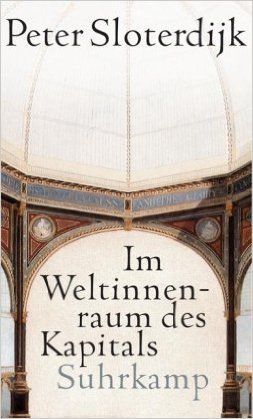
The “telling of grand tales” is also part of it, and Peter Sloterdijk’s book is undeniably a more valuable contribution to the discussion about globalisation than the ones made by the “amateurs” he refers to.
Author: Christophe de Landtsheer