The Meaning of Love: Shakespeare and Cervantes
Did Cervantes really believe in love? What kind of love? And Shakespeare? What’s the meaning of love in Shakespeare and Cervantes?

The only pure love in Cervantes’ novel is the one Don Quixote feels for Dulcinea of Toboso, a woman who doesn’t even exist, just a product of his imagination. Is our imagination the only possible place for love? Because… To know the other means to die or to live, and now I think in Morpheus:

To know the other and to destroy the dreams. That’s why Shakespeare killed Romeo and Juliet in six days to give them enough time to dream but not to really know each other? Is that how real love is?

The proper definition of love in Romeo and Juliet is not told by Romeo or Juliet but by their friend Mercutio:
MERCUTIO
O, then I see Queen Mab hath been with you.
She is the fairies’ midwife, and she comes
In shape no bigger than an agate stone
On the forefinger of an alderman,
Drawn with a team of little atomi O
ver men’s noses as they lie asleep.
Her wagon spokes made of long spinners’ legs,
The cover of the wings of grasshoppers,
Her traces of the smallest spider web,
Her collars of the moonshine’s wat’ry beams,
Her whip of cricket’s bone, the lash of film,
Her wagoner a small gray-coated gnat,
Not half so big as a round little worm
Pricked from the lazy finger of a maid.
Her chariot is an empty hazelnut,
Made by the joiner squirrel or old grub,
Time out o’ mind the fairies’ coachmakers.
And in this state she gallops night by night
Through lovers’ brains, and then they dream of love;
On courtiers’ knees, that dream on cur’sies straight;
O’er lawyers’ fingers, who straight dream on fees;
O’er ladies’ lips, who straight on kisses dream,
Which oft the angry Mab with blisters plagues
Because their breaths with sweetmeats tainted are.
Sometime she gallops o’er a courtier’s nose,
And then dreams he of smelling out a suit.
And sometime comes she with a tithe-pig’s tail,
Tickling a parson’s nose as he lies asleep;
Then he dreams of another benefice.
Sometime she driveth o’er a soldier’s neck,
And then dreams he of cutting foreign throats,
Of breaches, ambuscadoes, Spanish blades,
Of healths five fathom deep, and then anon
Drums in his ear, at which he starts and wakes
And, being thus frighted, swears a prayer or two
And sleeps again. This is that very Mab
That plats the manes of horses in the night
And bakes the elflocks in foul sluttish hairs,
Which once untangled much misfortune bodes.
This is the hag, when maids lie on their backs,
That presses them and learns them first to bear,
Making them women of good carriage.
This is she—
(Romeo and Juliet ACT 1. SC. 4)
Shakespeare and Cervantes’ love does not seem something positive. Maybe we have two big traditions in the western world about the concept of love, the Shakespearean and Cervante’s ideal and the Christian “caritas” tradition. We could contrast both to discover that could be different concepts. As Saint Paul said about love:
“If I speak in human and angelic tongues but do not have love, I am a resounding gong or a clashing cymbal. And if I have the gift of prophecy and comprehend all mysteries and all knowledge; if I have all faith so as to move mountains but do not have love, I am nothing.
“If I give away everything I own, and if I hand my body over so that I may boast but do not have love, I gain nothing. Love is patient, love is kind. It is not jealous, (love) is not pompous, it is not inflated, it is not rude, it does not seek its own interests, it is not quick-tempered, it does not brood over injury, it does not rejoice over wrongdoing but rejoices with the truth.
“It bears all things, believes all things, hopes all things, endures all things. Love never fails. If there are prophecies, they will be brought to nothing; if tongues, they will cease; if knowledge, it will be brought to nothing. For we know partially and we prophesy partially, but when the perfect comes, the partial will pass away.
“When I was a child, I used to talk as a child, think as a child, reason as a child; when I became a man, I put aside childish things. At present we see indistinctly, as in a mirror, but then face to face. At present I know partially; then I shall know fully, as I am fully known. So faith, hope, love remain, these three; but the greatest of these is love.
(1 Co 13: 1-13)
As Quixote said to Sancho about love:
Quixote: “I have oft told thee, Sancho, many times, that thou art too great a prattler and although thou hast but a gross wit, yet now and then thy frumps nip; but, to the end thou mayst perceive the faultiness of thy brain, and my discretion, I will tell thee a short history, which is this: There was once a widow, fair, young, free, rich, and withal very pleasant and jocund, that fell in love with a certain round and well-set servant of a college.
“His regent came to understand it, and therefore said on a day to the widow, by the way of fraternal correction, ‘Mistress, I do greatly marvel, and not without occasion, that a woman so principal, so beautiful, so rich, and specially so witty, could make so ill a choice, as to wax enamoured on so foul, so base, and foolish a man as such a one’.
“But she answered him thus, with a very pleasant and good grace: ‘You are, sir, greatly deceived, if you deem that I have made an ill choice in such a one, let him seem never so great a fool; for, to the purpose that I mean to use him, he knows as much or rather more philosophy than Aristotle’.
“And so, Sancho, is likewise Dulcinea of Toboso as much worth as the highest princess of the world, for the effect I mean to use her. And thus it is also sufficient for me to believe and think that the good Aldonza Lorenzo is fair and honest and I make account of her as of the greatest princess in the world, for none can equal her in fairness, and few come near her for a good report.
“And, for a final conclusion, I imagine that all that which I say is really so, without adding or taking aught away. And I do imagine her, in my fantasy, to be such as I could wish her as well in beauty as principality, and neither can Helen approach, nor Lucrece come near her. And let every one say what he pleaseth; for though I should be reprehended for this by the ignorant, yet shall I not, therefore, be chastised by the more observant and rigorous sort of men.”
(Don Quixote, Part 1. Third book, XI)
Miguel de Cervantes creates Don Quixote, a character who needs to build up a dream world to make his life worth living. Shakespeare’s last creation is Prospero, a magician who needs to invent a fantasy world on a desert island. Both of them fail and return to their real worlds disenchanted. Maybe this kind of behaviour is what Saint Paul talks when he said “When I was a child, I used to talk as a child, think as a child, reason as a child; when I became a man, I put aside childish things. At present we see indistinctly, as in a mirror, but then face to face.”
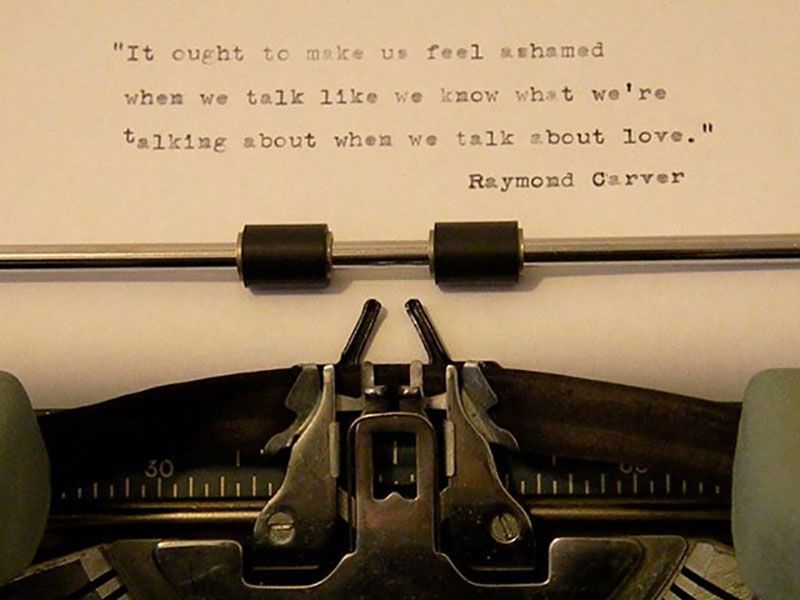
All this could be Raymond Carver’s dilemma in his short stories collection What We Talk About When We Talk About love?